
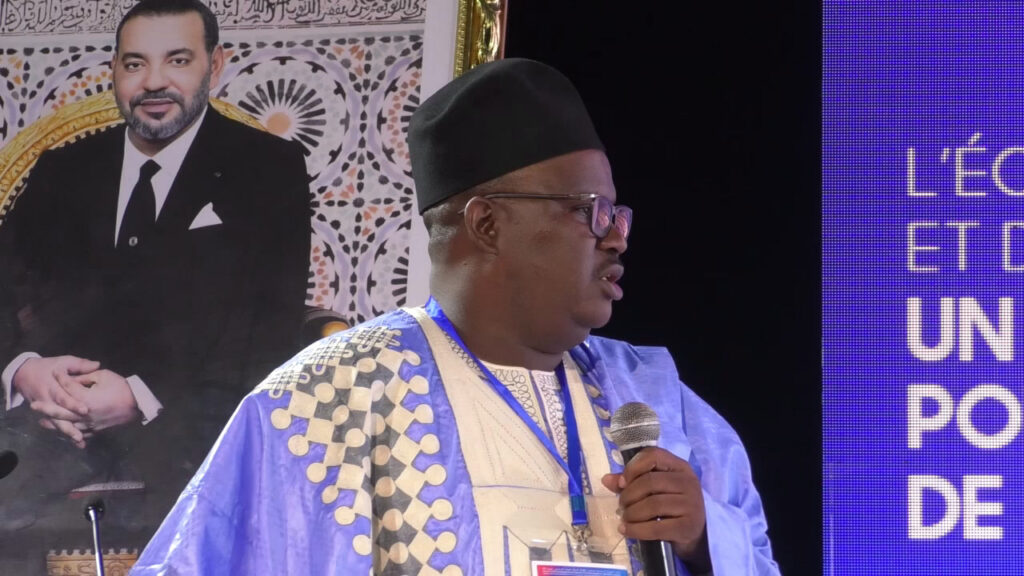
Casablanca, 21 October 2026. On Day 2 of the International Road Fair Logiterre 2026, GTTC national president Ibrahima Yaya laid out the realities of road transport in Central Africa, country by country. His message: the sub-region’s corridors are too slow and too costly, and he set out seven stakes to change that.
The third edition of Logiterre continued on Wednesday 21 October in Casablanca, Morocco, with presentations from sub-regional bodies and transport operators. Central Africa was presented by Ibrahima Yaya, who speaks for the sector at three levels. He is Vice President of UAOTL in charge of Central Africa, president of the Federation of Transporters of the Economic Community of Central African States (FETRANS-ECCAS), and national president of the Cameroon Road Transport Trade Union (GTTC).
His report was titled “The Corridors of Central Africa, 2015-2025 Balance Sheet: Challenges and Perspectives”. It gave an in-depth analysis of the situation in each member state.
Corridors at 6 km/h
Ibrahima Yaya first decried the slowness of the corridors. Goods move at an average of 6 km/h in West and Central Africa, against 11.6 km/h in North Africa.
Chad. For this landlocked country, he called for the modernisation of the logistics chain, including the Douala–N’Djamena corridor and the Bongor–Yagoua bridge. He also called for an end to the double seizure of goods.
Gabon. He called for a clear division of responsibilities between administrations, more regional dialogue, and the harmonisation of taxes and dues.
Cameroon: a decade of progress at the Port of Douala
Cameroon’s challenges and prospects took pride of place, led by the Port Authority of Douala’s decade of progress:
- administrative time at the port down from 12 days to 3;
- less time spent on weighing;
- 50,000 tonnes in transit to Nigeria in 2025, a record in the history of the Port of Douala.
Seven major stakes for the sub-region
President Ibrahima Yaya then presented the seven major stakes for Central Africa:
- Benefit from the African Continental Free Trade Area (AfCFTA). The AfCFTA is a market of 1.3 billion consumers, yet ECCAS records the lowest level of trade among Africa’s regional economic communities.
- Secure the corridors.
- Make ports and corridors competitive by cutting transit costs and delays, so as to keep national and international shippers.
- Preserve the road network by fighting overloading, which is responsible for the rapid degradation of roads, especially the Douala–Bangui road.
- Interconnect West and Central Africa: the Cameroon–Nigeria corridors, border markets and the harmonisation of axle loads.
- Develop the private sector by making road transporters actors of Africa’s industrial and economic sovereignty.
- Build sustainable, professional transport through driver training, road safety and lower carbon emissions (SDG 13).
2026-2027 action plan: next stop, Garoua
Presenting the 2026-2027 action plan, Ibrahima Yaya highlighted a joint GTTC–TRADEX SA exploration mission to Burkina Faso in 2027.
Before concluding, he spoke at length about three GTTC events coming up in December 2026:
- the 7th General Assembly of the GTTC;
- the 2nd NARTO–GTTC high-level consultation;
- the 4th edition of the GTTC Awards.
He extended an open invitation to all Logiterre participants. It bore fruit at once: UAOTL president Mustapha Chaoune announced that he would be in Garoua for the event. The GTTC president was warmly applauded for his presentation and his management style.
Busy stands and B2B meetings
Day 2 of Logiterre also brought high-profile visits to the GTTC stand, networking and B2B meetings. The UAOTL stand drew crowds too, as each sub-region explained its activities to curious visitors.
More on Logiterre, the international fair for mobility, transport and logistics, in our next articles.
Source: GTTC News, presented by Promise Akanteh.


Comments
Leave a comment
No comments yet. Be the first to share your thoughts!